Unpresidential Make North Korea Great Again Comic
-
Winter 2022
- Subscribe
- Magazine
- Online
- Weblog
- Podcasts
- Events
- Shop
- Login
- Most Us
- Donate
- Contact
- Annunciate
- Newsletter
-
The Lasting Implications of the Singapore Summit
The Lasting Implications of the Singapore Summit
The long-awaited meridian between Donald Trump and Kim Jong-un ended in a diplomatic agreement with the substance of cotton candy. But information technology nevertheless marked an important pace frontwards in the Korean peace procedure.
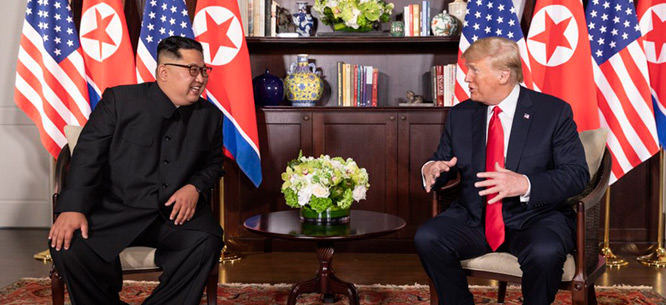
"Trump and Kim'south Excellent Adventure"—otherwise known as the Singapore Elevation—is easy to trash, and just well-nigh anybody has been. Takeaways include a diplomatic agreement with the substance of cotton candy. Donald Trump saluted a North Korean general while hawking the land's beaches like the Atlantic City existent-manor and casino developer he is. Kim Jong-united nations tried to climb into Trump'southward tricked-out Cadillac until his body guards gently restrained him (was he hoping to defect?). Dennis Rodman cried on televisions effectually the world in a "Make America Great Once again" hat and a PotCoin.com T-shirt.
While the outcomes of June 12, 2018 may be intangible, they are nonetheless significant. Is information technology possible to run across the summit'south potential without embracing Trumpism or North Korean gulags, given the history-defying nature of this history-making moment?
The current "winning/losing" narrative casts the The states equally summit "loser" because of Trump's blowing and his willingness to accede to some North Korean demands. What, though, would it hateful for North Korea to be the "loser"? At this stage of the game, it would likely mean state of war—a nuclear state of war—that Secretary of Defence James Mattis anticipates as "probably the worst kind of fighting in most people's lifetimes." Conservative projections, such every bit from the RAND corporation, detail hundreds of thousands, if not millions, of casualties (Korean, American, Japanese, and Chinese) followed by hundreds of thousands of U.S. and South Korean troops rushing into North Korea to secure the territory. (At that place is little mention of safeguarding the "mop-up" troops from the radiological nightmare that would follow).
The handshake that shook the world is worse?
Korea has long been Northeast Asia's all-time piece of real estate. With year-round accessible harbors and arable resource, during the modernistic era alone Korea endured Russian, Chinese, Japanese, and American attempts to control its country and people. In 1871, the United States was first out of the gate with "Our Piddling War with the Infidel" (in the racialized terminology of the solar day), which counted three dead Americans and 243 expressionless Koreans—establishing a disproportionate casualty ratio between Koreans and foreign invaders that would continue through the twentieth century.
The Singapore Summit hit "break" on the scenario of more state of war to command the Korean Peninsula, proffering economic development and sanctions relief in commutation for Pyongyang dismantling its nuclear weapons plan. Jokes about Trump Towers and casinos in North Korea dominated American coverage. Donald Trump has regularly appeared in recent Southward Korean cartoons as Napoleon or a Roman emperor. Yet together with N Koreans, South Koreans would deport the burden of any futurity war. The day after the summit, they appropriately demonstrated their overwhelming rejection of such a time to come in a nationwide election that saw landslide victories for candidates supporting the peace procedure—including governorships in regions of South korea that have never favored such policies. South Korean president Moon Jae-in is enjoying an 80 percent blessing rate for betting Korea's hereafter this style, and although North Koreans lack avenues for open expression under the current regime, for the offset time always, the state-controlled N Korean media is publishing manufactures about easing military machine tensions with Republic of korea and the United States.
With its over-the-pinnacle, fabricated-for-Hollywood moments and unusually vague diplomatic assurances, the elevation inadvertently succeeded in doing two things that will challenge the regime and ordinary N Koreans in the months to come in new and important ways. Only a few months agone, at the height of the "burn down-and-fury" rhetoric, the U.s. would likely have found little, if whatever, international support for countering a North Korean missile exam with the arsenal Washington withal threatens to utilize. The onus has shifted, all the same, compelling North Korean leaders to desist from what policy wonks call Pyongyang's "provocation bicycle" (they test; we sanction; they test; we offering aid or sanctions relief; they test over again; we sanction again; and and then on). Now, were he to launch a missile, Kim Jong-un would probable lose all of the "likes" he generated posing for selfies and cruising through the streets of Singapore.
The success of the summit too means that nosotros can focus on the humanitarian disaster that has been daily life for so many North Koreans for besides long. Nosotros accept known about the work camps, death camps, hereditary suffering, hunger, and impecuniousness for decades. Kim Jong-un has, as well, and he knows we know. Fighting these abuses by launching missiles at Democratic people's republic of korea only exacerbates these conditions, all the same, and enables the Northward Korean leadership to justify sustaining them. Opening Democratic people's republic of korea to the world is the merely way to alter this: whether it means assuasive international assist agencies entry to help convalesce tuberculosis, permitting foreign entrepreneurs to bolster North Korean efforts to restart or reconceive failed industries, or establishing wind farms in a country where energy is an immediate demand. And so, when Koreans finally own their social club and can concord their leaders answerable, we tin measure what happened in Singapore in June 2018. Until that bespeak, if we really are interested in a peaceful and progressive future for Korea, we need to piece of work with what we've got—on both sides of the Pacific.
Alexis Dudden is professor of history at the University of Connecticut.
Source: https://www.dissentmagazine.org/blog/lasting-implications-north-korea-singapore-summit-peace-process
0 Response to "Unpresidential Make North Korea Great Again Comic"
Post a Comment